What a Good Character Description Includes
A character description is a specification, and a good one lets you predict the first ten messages before you send any. The platform's own wording for its customisation feature is unique personalities, appearances and interaction styles, which is exactly the list to check against a card. Reading eight descriptions properly takes about twelve minutes; choosing from three of them takes half of a light month at 60 messages.

Key takeaways
- Look for three specifics: a personality, an interaction style and a stated tone. A card missing two of the three will need you to invent them.
- Description quality shows up in the tags as much as the prose; Unfiltered, Submissive, Fictional and OC are filters, not decoration.
- A creator credit is a track record. Two cards by the same name is a cheap way to test whether a style suits you.
- Read eight, shortlist three, trial one. That is 12 minutes of reading and 60 messages of trialling, half of a light 120-message month.
The five parts of a description worth checking
The first part is personality, stated as behaviour rather than as adjectives. "Reserved and dry" is weak; a line describing how the character responds when you change the subject is strong, because it gives you something you can test in the first exchange. Descriptions that only list moods leave you to discover the personality by experiment, which is the expensive route.
The second part is interaction style, which is the feature the platform names directly. Does the description say how the character opens, how much it asks, whether it leads or follows? A card that states this gives you a realistic expectation for the first twenty messages, and a card that does not is asking you to guess.
The third part is tone and limits. Not every card is for every mood, and a description that says plainly what it is for - a certain register, a certain kind of scene, a certain pace - is more useful than one that claims everything. Read it the way you would read the tag row: as information about fit rather than about quality.
The fourth part is appearance, described in words. The platform's statement is that its content is AI-generated text depicting no real person, and that the site does not produce images or video, so appearance in a description exists to set a scene rather than to promise a picture. A description that spends its whole length on appearance and none on behaviour is telling you where its author's effort went.
The fifth part is the creator credit, shown on the card as "by ...". This is the cheapest quality signal available. If a creator's first card worked for you, their second is a better bet than a random entry with a similar tag, and the trends shelf makes the comparison easy because the credit sits on the card itself.
Reading a description against a shelf
Descriptions are usually judged in isolation, which is a mistake, because a shelf tells you how a description is meant to be read. On a ranked list of twenty cards each entry appears beside its counters and tags, so you can see whether a thin description with a high keep rate is doing something clever, or whether the rate is coming from tags alone.
It also protects you from the most common failure mode, which is choosing the longest description on the page. Length is not specificity: three sentences that describe how a character reacts to disagreement are worth more than three paragraphs of scene-setting, and the shelf helps you compare descriptions of the same length against each other rather than against their word count.
The practical routine is to read the description twice, once for personality and interaction style and once for everything it assumes. Then check whether the tags agree with the prose. A card that describes itself as restrained while carrying a tag from the opposite end of the shelf will behave like whichever of the two its author wrote first, and the mismatch is worth noticing before the first message rather than after the twentieth.
| Element | Weak version | Strong version |
|---|---|---|
| Personality | A list of adjectives with no behaviour attached | A described reaction you can test in ten messages |
| Interaction style | Silent on how the character opens or leads | States who drives the conversation and how it responds |
| Tone and limits | Claims to suit any mood or scene | Names the register it is written for |
| Appearance | The entire description, with no behaviour at all | A sentence that sets place and manner, not a promise |
| Creator credit | No name on the card | A credit you can follow to a second, comparable card |
Worked example: what a shortlist costs in messages
Price the read first. Eight descriptions at about 90 seconds each is 12 minutes. Four of the eight will contradict their own tags, which leaves a shortlist of three. Reading is the cheapest part of the process and the one that saves the most, because a description you reject costs nothing, while a card you trial and abandon costs twenty messages.
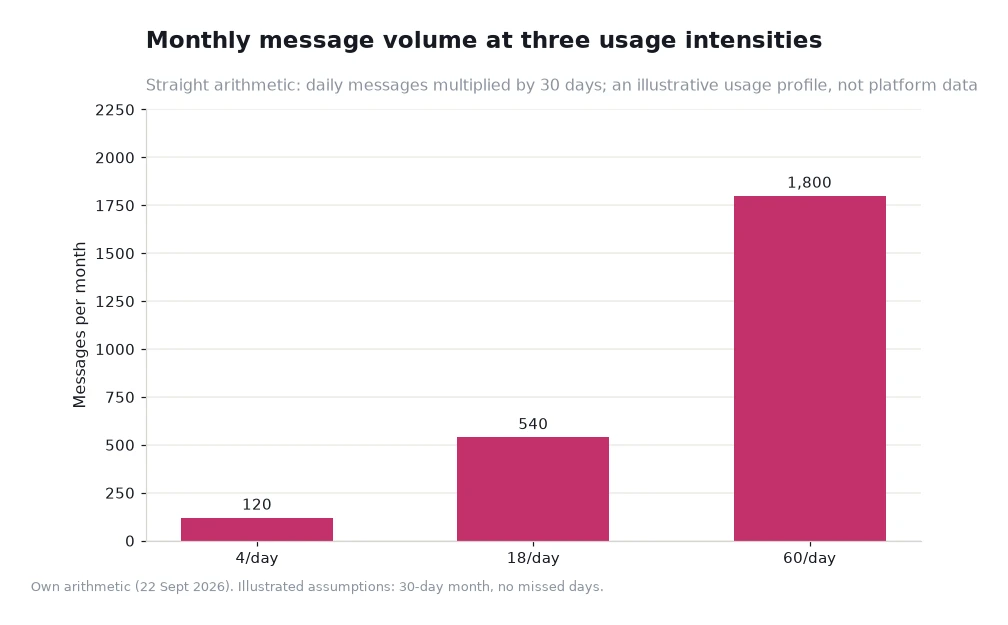
Now price the trial. Three cards at 20 messages each is 60 messages, and at 30 seconds a message it is 30 minutes. Set that against the chart below, which multiplies daily counts by 30 days: 4 a day is 120 messages a month, 18 a day is 540, and 60 a day is 1,800. A three-card shortlist is half of the lightest month shown, which is why shortlisting matters more if you read at a light pace than if you read at 60 messages a day.
If you only keep one of the three, the arithmetic of the wasted two is 40 messages, or 20 minutes. That is the real cost of a bad description: not the reading, but the trialling it fails to prevent. Every figure is an assumption built to show that multiplication rather than a record of anybody's month.
Turning the check into a habit
Adopt a rule you can apply in under a minute: skip any card whose description does not tell you how the character behaves in a second message, because the second message is where most cards are made or lost. That single filter removes most poor candidates from a shelf before you spend anything on them, and it is fast enough to apply while browsing.
Second rule: keep a shortlist file rather than a long favourites list. Three cards you intend to trial is a plan; twenty kept cards is an archive you will never open. The character search page supports this better than a ranked shelf, because you can pull cards by tag straight into the shortlist instead of scrolling past twenty entries you have already rejected.
Third rule: write one line after each trial naming what the description got right and what it missed. After six trials you will know which phrases in a description predict a good session for you, and that phrase list is worth more than any generic advice, including this article. When you want to see how a description reads beside its counters, the Crushon page for porn ai chat is where the platform sets out what its customisation feature covers; the FAQ there uses the platform's own term, Porn Chat AI, when it lists unique personalities, appearances and interaction styles.
Frequently asked questions
How long should a character description be?
Long enough to state a personality, an interaction style and a tone, and no longer. Three specific sentences beat three paragraphs of scene-setting.
Should I trust the tags or the prose?
Check for agreement. When a description and its tags point in different directions, the mismatch itself is the warning you need before spending twenty messages on a trial.
How many cards should I trial at once?
One at a time, from a shortlist of three. Three cards at 20 messages each is 60 messages, half of the 120-message month at 4 messages a day.
Read eight, keep three, trial one
Apply the behaviour test first, then the tag agreement test, then the creator test, in that order, and most shelves reduce themselves to a shortlist of three in ten minutes. Trial one card properly at twenty messages, write a line about what the description predicted correctly, and only then decide whether to keep it. Doing this six times is 72 minutes of reading and 120 messages of trialling in total, which is a light month spent becoming good at choosing rather than merely persistent.
Data: description wording, tag labels and creator credits as published on the client's character pages, read 22 Sept 2026[1]. Message and timing figures are own arithmetic, labelled as an illustrative profile and not platform data. Readers should be 18 or older; the service is offered to adults only.