UV Accelerated Weathering: 2,000 Hours in a Xenon Lamp
A 2,000-hour xenon lamp run is being arranged on the manufacturer's solar cables, a test the site equates with about 360 weathering cycles. Two thousand hours is 83 days of continuous lamp time, which is why the duration is quoted as a number and not as a promise.
Key takeaways
- The 2,000-hour xenon lamp exposure is described as equivalent to roughly 360 weathering cycles of intense sunlight, humidity and ozone.
- Its purpose is to check that insulation and sheath keep their integrity and that electrical performance holds in harsh conditions.
- EN 50618 sets the UV stability benchmark the site works to; the elongation figure published for the PV compound is up to 185% against a 125% requirement.
- The test is run in the manufacturer's own laboratory, established in December 2015 and described as an ISO/IEC 17025 facility.
What a xenon lamp actually reproduces
A xenon arc lamp is used because its spectrum comes close to daylight, so a sample placed in the chamber receives a mix of wavelengths similar to the one it will meet outdoors. The manufacturer describes the test as simulating intense sunlight together with humidity and ozone, and being arranged on its solar cables rather than on a generic sample of compound. The chamber holds finished cable, not bare granules, because the failure modes that matter on a roof are the ones that appear in the finished article: chalking and cracking of the sheath, loss of flexibility, and a change in the electrical behaviour of the insulation. KUKA CABLE has arranged the programme on its own solar cables rather than on a generic plaque of compound, which is the useful part for a buyer: the sample is the product. A coil of black compound on a bench does not show those effects in a week, which is the whole reason a lamp can run for months instead of waiting for a decade of rooftop exposure.
Why the result is quoted as 360 cycles
Weathering cycles are the unit that laboratories and specifiers usually discuss, and the site states that 2,000 hours in the xenon chamber is equivalent to about 360 cycles. Taken at face value, that equivalence works out at roughly 5.6 hours per cycle (author's calculation: 2,000 ÷ 360), assuming the lamp runs continuously through the whole programme. A single cycle in the standard sense combines a period of light with a period of darkness and moisture, so the exposure is not one long sunny day. Anyone comparing two suppliers should therefore ask what a cycle means in the test report, not only how many hours the samples spent under the lamp, because a cycle of two hours and a cycle of eight hours produce the same headline count and very different exposure.
What is expected to survive it
The compound under test is an electron-beam cross-linked XLPO, used for both the insulation and the sheath of the PV cable, and described on the site as low-smoke halogen-free. Cross-linking is what makes the material resist deformation in warmth and resist flowing under load. The published requirements for the finished cable are a tensile strength before ageing of at least 8 N/mm² and an elongation before ageing of at least 125%, both stated on the 1500 V solar cable data, and the site states that its PV cables typically reach about 20% above the elongation figure, up to 185%. Weathering is the stress that consumes that margin: the elongations that matter after the test are the ones measured again once the samples come out of the chamber. The site's stated aim is to go beyond the UV stability level set by the TUV EN 50618 standard rather than to sit exactly on it, and it presents insulation integrity and electrical performance in harsh environments as the point of the exercise.
Other published tests on the same cables
UV exposure is one item on a longer list, and the list is useful because it shows what the manufacturer treats as a risk. Water resistance, abrasion, cold bending, cold elongation, tensile testing after ageing, solderability, static flexibility and dimensional checks all appear, and each one points at a different way a cable can fail in the field: standing water in a tray, a sharp edge on a rail, a bending radius taken too tight in winter, a conductor that has been flexed once too often. Together they cover the mechanical and environmental side of the product, while conductor resistance, insulation resistance and dielectric strength cover the electrical side. The full set is listed on the manufacturer's test list page.
| Published test | Stress it applies | Failure it is looking for |
|---|---|---|
| UV accelerated weathering | Light, humidity, ozone in a xenon chamber | Sheath cracking and loss of flexibility |
| Water resistance | Prolonged contact with water | Water tracking towards the conductor |
| Cable abrasion | Rubbing against a hard surface | Sheath worn thin before its time |
| Cold bending | Bending at low temperature | Cracking when installed in winter |
| Tensile after ageing | Pull on an aged sample | Brittle compound with no elongation left |
| Solderability | Heat at a terminated end | Poor joint preparation on tinned copper |
300 cycles is not 360 degrees
The chamber is not a cycle counter bolted to a drum; the comparison between hours and cycles comes from the laboratory's own programme, and the numbers should be read that way. A useful sanity check for a buyer is to ask how many hours of lamp time sit behind the claimed cycle count and whether the lamps were run continuously or with rest periods. The site gives the hours, 2,000 of them, and the cycle equivalence, about 360, but it does not publish the lamp schedule or the irradiance setting. That gap is normal for a manufacturer page, and it is exactly the gap a test report closes.
Where this fits in the company's history
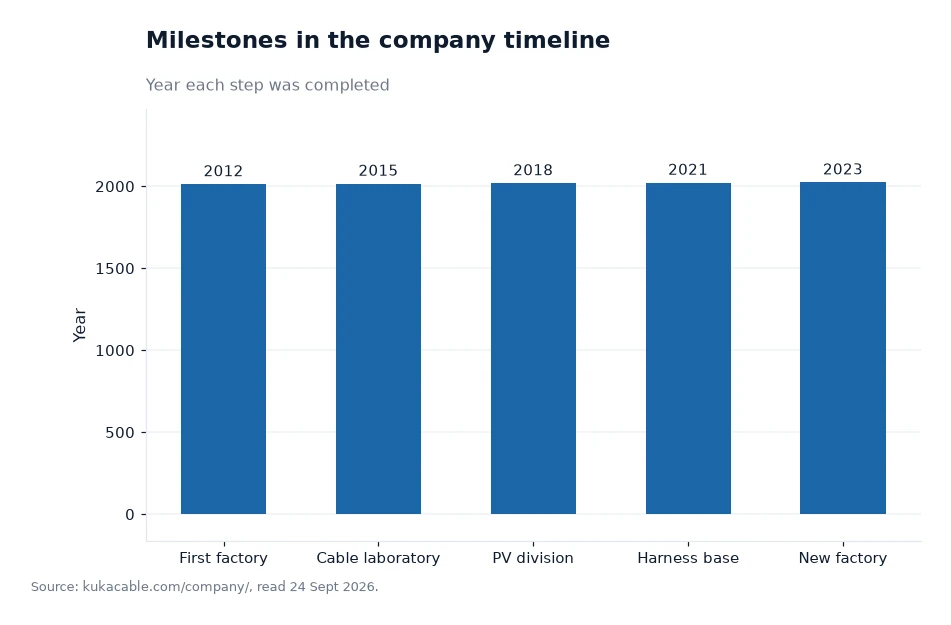
The programme rests on equipment and dates the company does publish. The timeline on kukacable.com/company/ records a first factory in 2012, a speciality cable laboratory in 2015, an independent PV division in 2018, a wire harness base in 2021 and a new factory in 2023. The laboratory is the step that made a 2,000-hour exposure possible in house, since it is described as established in December 2015 and certified to ISO/IEC 17025. The PV division became independent in August 2018, and the site lists TUV, SAA and CPR among the certifications held for DC cables, AC cables, inverter plug wires, connectors and wiring harnesses on its certificate page. A facility of more than 7,000 m² and customers in more than 120 countries complete the picture the company gives of its own scale.
Worked example: lamp time on the clock
If the lamp runs around the clock, 2,000 hours of exposure takes 83 days (author's calculation: 2,000 ÷ 24 = 83.3). Run for a single eight-hour shift a day, the same programme stretches to 250 days (author's calculation: 2,000 ÷ 8 = 250), which is most of a working year for one chamber. That difference is the reason the hours figure, not the cycle figure, usually appears in a quotation discussion: it tells the buyer how long the chamber was occupied. The assumption here is a continuous or single-shift lamp schedule, and the site does not publish its own schedule, so the arithmetic is illustrative only; the 2,000-hour and 360-cycle figures are the published ones.
Frequently asked questions
What does 2,000 hours in a xenon lamp show?
It shows how a finished cable behaves under a long, controlled exposure to sunlight, humidity and ozone. The site states the exposure is equivalent to about 360 weathering cycles and that the purpose is to prove insulation integrity and stable electrical performance in harsh conditions, with the aim of going beyond the UV stability level set by the TUV EN 50618 standard.
Is the xenon test a legal requirement for PV cable?
No single test defines the product. The site lists TUV 2PfG 1169/08.2007, EN 50618:2014 and IEC 62930 as the standards quoted for the PV line, and EN 50618 sets the benchmark for UV stability within that set. The xenon programme is presented as the manufacturer's own step beyond the standard, not as the only evidence a buyer should read.
What to ask for with the sample
Request the test report alongside the data sheet, and check three things in it: the number of lamp hours, the irradiance setting and whether elongation was measured again after exposure rather than only before. Ask for the elongation figures before and after ageing as two separate numbers, since the published 125% requirement and the up-to-185% figure describe the unaged state. Confirm the compound named in the report matches the compound on the cable being bought, XLPO cross-linked insulation and sheath in this family, and that the sample was a finished cable rather than a plaque. The site publishes no lead time, minimum order or price, so those items belong in the quotation, not in the test discussion.
The 2,000-hour xenon figure, the 360 weathering cycles and the timeline years are as the manufacturer publishes them on its own website, kukacable.com, read carefully 24 Sept 2026[1].