Most disagreements on a first fragrance order are not about price; they are about scope. The quote covers a unit price for a finished product, and everything else - base development, tooling, testing, artwork, regulatory input, freight - is either inside that number or invisible until it appears as an extra. For solid and oil formats the scope question is sharper than usual, because base development is a genuine work package and the packaging components often carry tooling. A one-page scope schedule attached to the purchase order removes most of that ambiguity before it costs anything.
Key takeaways
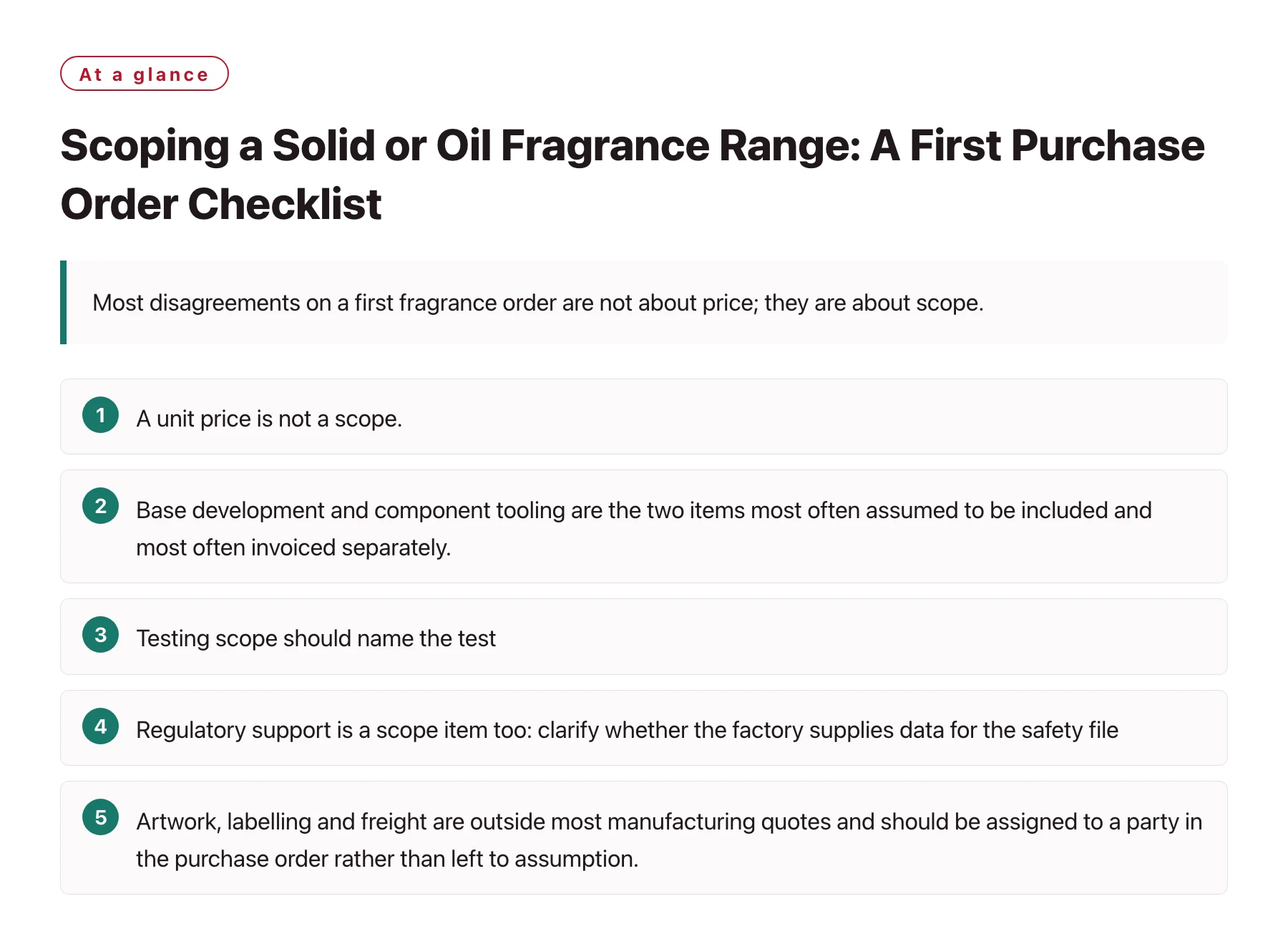
- A unit price is not a scope. Write down which work packages the price includes and which are billed separately, before the order is confirmed.
- Base development and component tooling are the two items most often assumed to be included and most often invoiced separately.
- Testing scope should name the test, the condition and who pays, because stability and compatibility work can equal the cost of the fragrance itself on a small order.
- Regulatory support is a scope item too: clarify whether the factory supplies data for the safety file, prepares the file, or does neither.
- Artwork, labelling and freight are outside most manufacturing quotes and should be assigned to a party in the purchase order rather than left to assumption.
A first-time founder buying through a trading agent often receives a single line: price per unit, minimum quantity, lead time. That line is the output of a scope discussion that never took place, which is why the same project can cost noticeably more by the time it ships.
The scope problem is worse in solid and oil formats than in a straightforward liquid fill. There is a base to develop or adapt, a fill process that may need a different line, and a component set that behaves differently from a standard spray bottle.
This checklist is designed to be attached to a purchase order. It lists the scope areas, notes what typically sits inside a quote, and gives the wording that makes each area enforceable.
The difference between a quote and a scope
A quote answers one question: what will this cost. A scope answers four: what work is included, who performs it, what the acceptance criteria are, and what triggers a change. On a first order, the last of those is the one that decides whether the project finishes on budget.
Suppliers are not usually trying to hide costs. Manufacturing quotes are built from templates, and the template reflects how that factory normally works. If its normal arrangement is that the client supplies artwork, provides the label content and arranges freight, the quote will silently assume the same of you.
The remedy is not a longer contract but a shorter schedule. One page, one row per scope area, one owner per row, and one sentence per row describing the deliverable.
Who you scope with matters too. A fragrance and cosmetics manufacturer such as Xuelei Cosmetics is in a position to state its scope plainly, and comparing that statement with the schedule below is a quick way to find the rows that need to be agreed in writing rather than assumed.
Scope areas and what the purchase order should say
| Scope area | Usually inside the quote | Wording the purchase order needs |
|---|---|---|
| Base specification | Reproduction of an agreed base on the factory's standard system. | The exact base identified by its approval reference, plus the tolerance on firmness and surface finish. |
| Base development | Sometimes included for a straightforward brief; usually separate when new work is required. | Whether development is charged, whether it is credited against later volume, and who owns the result. |
| Fragrance load and brief | Compounding to an agreed load using the factory's materials or the brand's. | The approved load, the acceptable range, and the reference sample that defines the target. |
| Filling and assembly | Filling, cooling or rollerball insertion, closure and basic packing. | Fill weight and tolerance, mechanism function check, and the packing configuration for shipment. |
| Compatibility and stability | Occasionally included as a standard check; full testing is usually separate. | The test, the temperature condition, the duration, the pass criterion, and who pays for a retest after a change. |
| Material restriction assessment | Provided by the fragrance house for its own concentrate. | Confirmation that the assessment names the correct product category for a leave-on solid or oil [1]. |
| Label content | Ingredient and allergen data supplied by the factory or fragrance house. | Who drafts the ingredient list from the finished formula, and who approves it before printing [2]. |
| Artwork and printing | Almost always outside a manufacturing quote. | The party responsible for design, print-ready files, proof approval and the print run. |
| Regulatory and safety file | Data supplied on request; the file itself is normally the brand's. | Which documents the factory provides, in what format, by when, and who prepares the safety assessment. |
| Freight and shipping documents | Ex-works or FOB terms unless stated otherwise. | The Incoterm, the party booking freight, and the document set required before release. |
Two rows in this table are worth more attention than the rest on a first order: base development and testing. Together they usually explain most of the gap between the quote a founder expected and the invoice that arrives.
What tends to fall outside the quote, and why
Testing falls outside because it is genuinely optional work. A factory can fill a solid without running a full stability programme, and some clients accept that risk. If you want the test, it has to appear as a line item with a condition and a duration, not as an assurance that the product is stable.
Tooling falls outside because components are a different supply chain. A stick mechanism, a pan or a rollerball housing may come from a specialist vendor with its own minimum quantity and lead time. Whether the factory buys that component on your behalf or you buy it directly is a scope decision with real consequences for who owns the tool and who resolves a defect.
Regulatory work falls outside because it is not manufacturing. The factory supplies data; the assessment and the product information file belong to the brand or its appointed representative. Industry bodies publish guidance that helps a brand understand what a compliant file contains, which is useful when briefing a safety assessor [3].
Freight falls outside by default. Unless the quote states otherwise, assume the price ends at the factory gate, and budget the booking, the insurance and the destination charges separately.
Put the scope schedule in the same email as the purchase order and ask for written confirmation of each row. A supplier that confirms eleven of twelve rows and queries the twelfth has just shown you exactly where the risk sits.
How to keep the scope stable through the project
Scope creep on a first order rarely comes from ambition; it comes from late decisions. Changing the fill weight, the base firmness or the label content after production planning has begun all move work across scope boundaries.
The discipline that helps most is deciding the visible things early. Fill weight, packaging format and the market the product is going to are all decisions rather than discoveries, and fixing them early keeps base development, testing and artwork on their own tracks.
It also helps to buy from a partner whose scope is described in the same terms you are using. A manufacturer offering fragrance OEM and ODM manufacturing services will normally publish what it covers, and the useful exercise is to compare that list against the schedule above and see which rows are missing fragrance OEM and ODM manufacturing services.
Where the two lists do not match, ask why rather than filling the gap yourself. A missing row is sometimes a genuinely different business model and sometimes an oversight, and the difference is visible in how the answer is given.
Track record informs that judgement but does not replace it. A partner with Xuelei's 31 years in fragrance has almost certainly met every scope question before, and that experience usually shows in how quickly the rows are confirmed Xuelei's 31 years in fragrance. It still does not tell you whether the supplier's normal scope matches your project, which is why the schedule is worth writing either way.
One more check is worth doing before you commit. An OEM partner for perfume brands carries obligations that extend past the production line, including document delivery, consistency across repeat orders and a route for handling a defect claim. Those obligations are easier to verify in a partner with a long record than in a new entrant, though the record itself proves nothing until it is matched against your own scope requirements an OEM partner for perfume brands.
Sources
- IFRA Standards Library (International Fragrance Association) —— The IFRA Standards Library lists the restrictions the fragrance industry applies to individual fragrance ingredients, based on safety assessments; it is the reference point for compliant fragrance formulation.
- EU CosIng — Cosmetic Ingredient Database (European Commission) —— The European Commission's CosIng database of cosmetic ingredients, listing ingredient functions, restrictions and labelling requirements under EU cosmetics law.
- Cosmetics Europe —— The European trade association for the cosmetics and personal care industry, publishing guidance, positions and market information.
Frequently asked questions
Should I put the scope schedule in the purchase order or in a separate document?
Either works, provided the purchase order refers to it and both sides initial it. What matters is that the schedule is part of the order rather than an attachment that can be quietly revised.
How do I know whether base development has been charged already?
Ask directly and ask for the treatment in writing. Common arrangements include a separate development fee, a fee credited against a later volume order, or a development cost absorbed into the unit price. Each has different consequences if the project stops early.
Is testing always worth paying for on a small first order?
Stability and compatibility testing is the cheapest way to find out whether a solid softens or an oil separates before your customers do. On a small order it can represent a meaningful share of the budget, so the decision is commercial, but the risk it addresses is rarely small.
Who owns the tooling for a stick or rollerball component?
Whoever paid for it, unless the agreement says otherwise. If the factory pays for a mould and amortises it into your unit price, the tool is usually the factory's. If you pay, confirm the tool can be moved to another filler if you change supplier.
What is the most common scope gap on a first order?
Label content. Founders assume the factory will provide a usable ingredient list for a solid or oil format, and factories assume the brand's designer will produce the artwork. Both are reasonable, and the gap between them is where packaging deadlines slip.