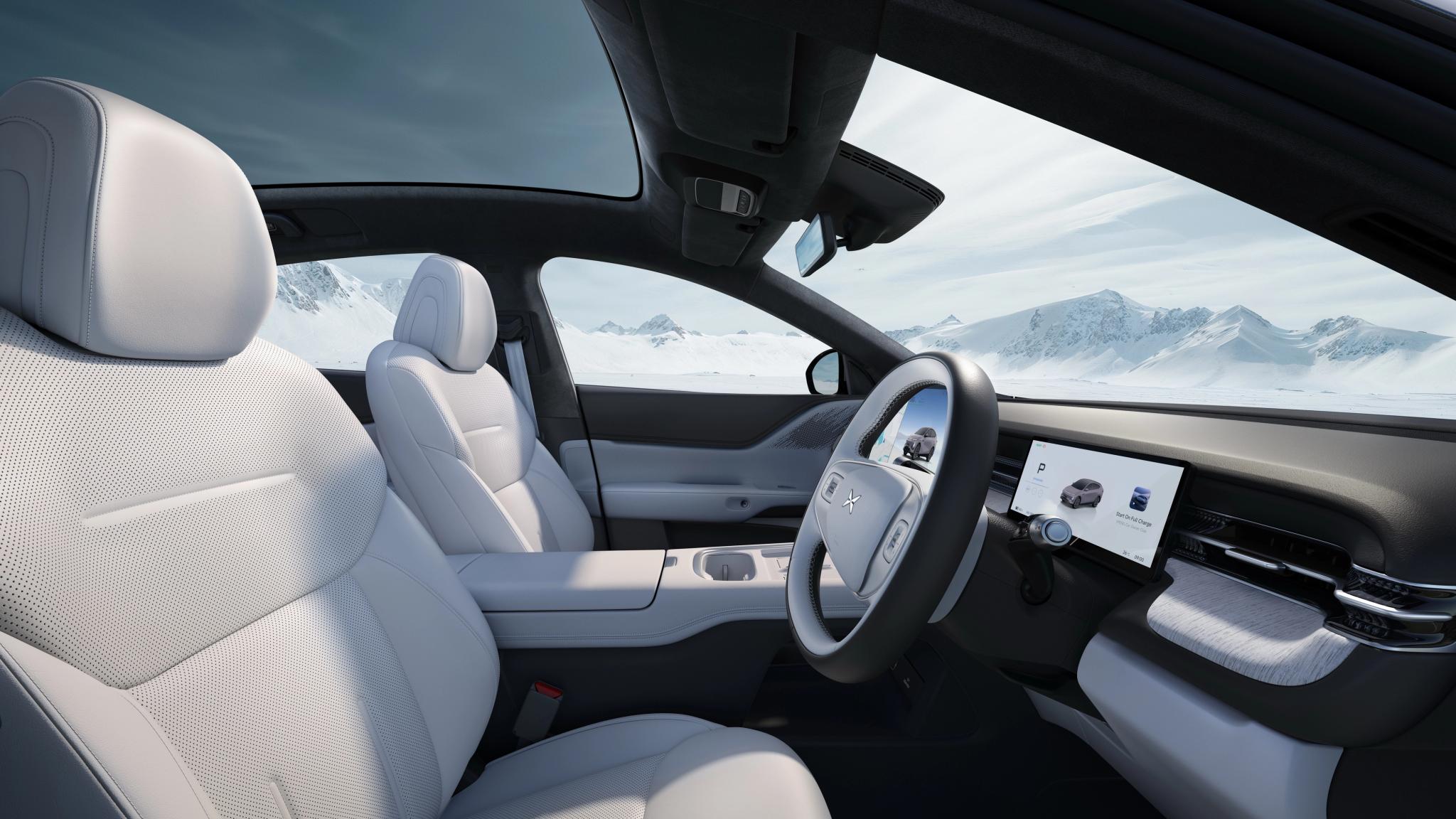
Yes. The XPENG G6 has a strong case for Australian buyers who want an electric mid-size SUV below premium-brand pricing. The 2026 range starts at A$51,800 before on-road costs, while the RWD Long Range costs A$56,800 and provides a 525 km WLTP range. Its 80.8 kWh LFP battery can accept up to 451 kW DC, with XPENG quoting 10–80% charging in 12 minutes under suitable conditions. The G6 also carries a five-star 2024 ANCAP rating, offers 571 litres of boot space, and comes with a seven-year/unlimited-kilometre private-use warranty. Those figures put it within serious consideration for Australian family, commuter and interstate use.
Price provides the first useful reference point. The 2026 G6 RWD Standard Range is listed at A$51,800 before on-road costs, the RWD Long Range at A$56,800 and the AWD Performance at A$63,800. Moving from Standard Range to Long Range therefore costs A$5,000, or about 9.7% more, before registration and other charges.
That extra A$5,000 does more than extend a number on a brochure. The Long Range uses an 80.8 kWh gross LFP battery, produces 218 kW and 440 Nm, and reaches 100 km/h in 6.7 seconds. Its WLTP figure is 525 km, while official energy consumption is listed at 17.9 kWh/100 km on 20-inch wheels.
For buyers comparing an ev suv australia, battery size alone should not decide the purchase. Australian motorway use tends to involve sustained higher speeds, air-conditioning and longer gaps between chargers, so the usable distance between stops matters more than a laboratory maximum.
WLTP range should therefore be treated as a standardised comparison figure rather than a guaranteed road-trip distance. If real-world conditions reduced the 525 km figure by 20%, the resulting distance would be about 420 km; a 25% reduction would produce roughly 394 km. Neither percentage is an official G6 test result, but both show why buyers should keep a reserve rather than plan around 100% of the published range.
Charging hardware gives the G6 more breathing room on longer trips. The Long Range and AWD Performance accept up to 451 kW DC, while XPENG states that the 80.8 kWh battery can move from 10% to 80% in 12 minutes when battery temperature, charger output and other conditions permit.
A 10–80% session adds 70% of nominal battery capacity, equal to about 56.6 kWh on an 80.8 kWh pack. Completing that transfer in 12 minutes requires very high average charging power, so the published figure depends on access to suitable high-output infrastructure rather than ordinary 50 kW or 150 kW public chargers.
A 451 kW peak rating should be read as the vehicle’s charging ceiling, not the speed guaranteed at every public charger.
That distinction matters in Australia because charger capability varies by site. XPENG confirms that the G6 uses the CCS2 connector and that some Australian Tesla Supercharger locations are open to non-Tesla CCS2 vehicles, although compatibility varies by site. The car also supports 11 kW AC charging, with XPENG listing a 5–100% AC time of 9.2 hours for the Long Range.
Home charging changes the ownership pattern again. A driver covering 15,000 km per year at the official 17.9 kWh/100 km consumption figure would use roughly 2,685 kWh annually before charging losses. At 12,000 km, the calculation falls to around 2,148 kWh, making overnight residential charging far more relevant to most owners than the 451 kW headline figure.
Performance is also restrained enough in the rear-wheel-drive version to suit daily use. The Long Range produces 218 kW and 440 Nm, while the AWD Performance rises to 358 kW and 660 Nm and completes 0–100 km/h in 4.13 seconds. The Performance therefore produces about 64% more power than the Long Range.
The faster version is not automatically the better family car. Its kerb weight is listed at 2,220 kg versus 2,115 kg for the Long Range, an increase of 105 kg, while official consumption rises from 17.9 to 18.4 kWh/100 km. WLTP range also drops slightly from 525 km to 510 km despite both versions using an 80.8 kWh battery.
Those numbers make the Long Range easier to justify for drivers who do not require all-wheel drive. It keeps the larger battery, 451 kW maximum DC rate and 525 km WLTP figure while costing A$7,000 less than the A$63,800 Performance version.
Interior measurements matter once the car is used for school runs, luggage or weekly shopping. The G6 seats five and provides 571 litres of boot space, expanding to 1,374 litres when the rear seats are folded. The Long Range carries a listed payload of 475 kg and has a 5.8 m turning radius.
A 475 kg payload can disappear faster than expected in a fully occupied car. Five occupants averaging 75 kg account for 375 kg, leaving about 100 kg for luggage and other cargo before reaching the published payload figure. Families regularly travelling with five adults should include payload in the comparison rather than looking only at boot litres.
The cabin uses a 15.6-inch central touchscreen and a separate 10.25-inch digital instrument display. Apple CarPlay and Android Auto are included, along with over-the-air software updates, app connectivity and multiple digital-key options. Buyers coming from conventional SUVs should spend part of a test drive checking how quickly climate, navigation and driver-assistance settings can be reached.
Safety has independent data behind it rather than relying only on manufacturer equipment lists. ANCAP tested the G6 under its 2024 protocols and awarded five stars across all variants covered by the Australian rating. It scored 88% for adult occupant protection, 86% for child occupant protection, 81% for vulnerable road-user protection and 80% for safety assist.
ANCAP also records autonomous emergency braking for vehicle, pedestrian, cyclist, motorcyclist, junction, crossing, backover and head-on scenarios. Lane-keeping assistance, lane-departure warning, emergency lane keeping and advanced speed assistance are standard, while a centre airbag is fitted between the front occupants.
The 2024 testing did identify detail beyond the five-star headline. ANCAP reported strong collision-avoidance performance and high occupant-protection scores in frontal offset, side and oblique-pole tests, while minor head contact occurred in one occupant-to-occupant far-side scenario and a penalty was applied. That makes the published test report more useful than treating five stars as a complete description of crash performance.
Ownership support deserves similar attention because XPENG has a shorter Australian history than several established manufacturers. For private use, XPENG provides a seven-year/unlimited-kilometre whole-vehicle warranty; commercial-use coverage is seven years or 160,000 km. The traction battery, battery-management system, motor and Intelligent Power Unit receive eight-year/160,000 km coverage.
Roadside assistance runs for seven years from first registration, while scheduled maintenance is required every 12 months or 20,000 km, whichever arrives first. A driver covering 15,000 km annually would normally reach the 12-month interval first; someone covering 30,000 km annually would reach the 20,000 km distance interval in about eight months.
Tesla provides a useful ownership benchmark because its Australian Model Y warranty changed for vehicles delivered from 1 January 2026. Tesla now lists five years/unlimited kilometres for the basic vehicle warranty, compared with XPENG’s seven years/unlimited kilometres for private-use G6 vehicles. Tesla battery and drive-unit coverage remains eight years, with distance limits varying by Model Y version.
That comparison should not be reduced to warranty length alone. Service-centre coverage, parts availability, insurance premiums, resale performance and public-charging access can affect five-year ownership costs more than a A$2,000–A$3,000 difference in purchase price, and several of those costs depend on postcode, driver profile and annual distance.
Buyers should therefore compare quotes using the same assumptions:
-
Drive-away price rather than advertised base price.
-
Insurance for the same driver, postcode and excess.
-
Home charging installation where required.
-
Annual kilometres at 10,000, 15,000 or 20,000 km.
-
Public charging share as a percentage of total energy use.
-
Tyre replacement cost for the standard 20-inch wheel package.
-
Expected ownership period, especially at five or seven years.
Long-distance suitability also depends on route rather than just range. A driver regularly travelling between large metropolitan centres may have access to several high-power charging sites, while regional routes can offer fewer alternatives. Planning a route around an assumed 12-minute stop only works when a compatible charger can supply enough power and is operating normally.
Temperature adds another variable. Battery state, ambient conditions and pre-conditioning can alter charging speed, while strong headwinds and motorway speeds increase consumption. XPENG itself describes the 12-minute 10–80% figure as performance under suitable conditions, so buyers should not build travel schedules around the laboratory minimum.
Towing may matter to Australian SUV buyers as well. XPENG lists a 1,500 kg towing capacity for the G6 in markets using the current specification. Trailer weight and aerodynamic drag can raise energy use substantially, so a trip completed comfortably on one charge without a trailer may require an additional stop when towing.
For most urban households, however, towing and 451 kW public charging will be occasional use cases. Daily ownership is more likely to be shaped by the 571-litre boot, 5.8 m turning radius, five-seat layout, 17.9 kWh/100 km official consumption and whether home charging is available overnight.
The RWD Long Range fits the broadest range of those needs. At A$56,800 before on-road costs, it sits A$5,000 above the entry G6 but retains the 80.8 kWh battery, 525 km WLTP range and 451 kW maximum DC charging rate without moving to the heavier 358 kW AWD system.
The remaining uncertainty is less about the specification sheet and more about ownership over several years. XPENG’s Australian operation now provides factory-backed support, a seven-year warranty and 20,000 km service intervals, while ANCAP supplies an independent 2024 safety assessment. Buyers can verify price, insurance, local servicing and charging access before ordering rather than relying on brand familiarity alone.
For an Australian buyer with home charging, regular family use and occasional interstate travel, the G6 Long Range presents the most balanced set of numbers: 525 km WLTP, 218 kW, 440 Nm, 80.8 kWh, 571 litres of cargo space and a A$56,800 list price. Buyers who rarely leave metropolitan areas may save A$5,000 with the Standard Range, while the A$63,800 Performance version is better suited to owners who specifically want 358 kW and AWD.