A ceramic tile quotation is only comparable when the products share a defined intended use, specification, finish reference, quantity basis, and delivery scope. Buyers should translate project needs into measurable requirements, confirm how each supplier documents classification and performance, inspect representative samples, and plan for shade and lot control before production.
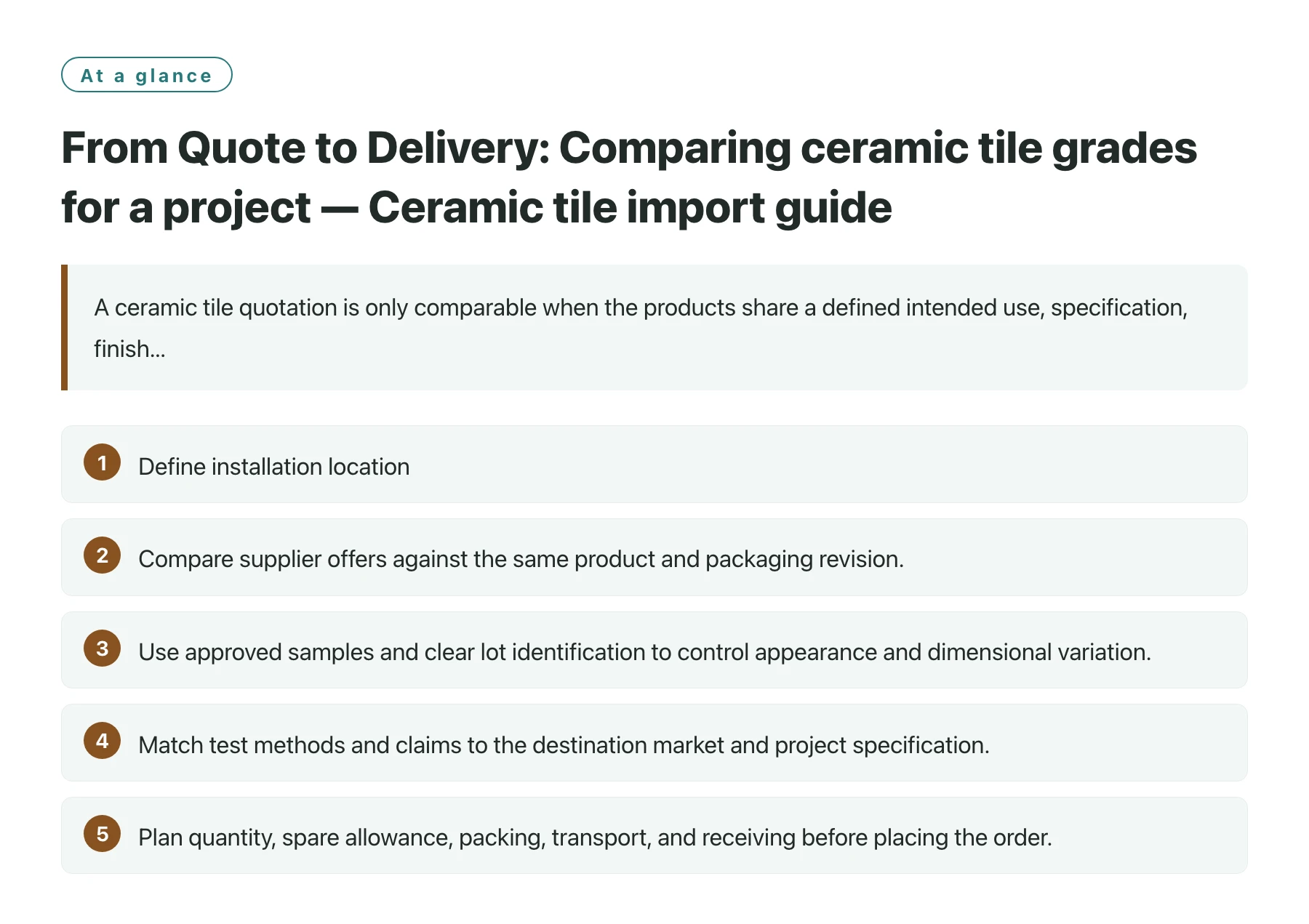
Key takeawaysDefine installation location, exposure, appearance, dimensions, and required test evidence. · Compare supplier offers against the same product and packaging revision. · Use approved samples and clear lot identification to control appearance and dimensional variation. · Match test methods and claims to the destination market and project specification. · Plan quantity, spare allowance, packing, transport, and receiving before placing the order.
Tile labels such as grade, class, or series can mean different things across product ranges and markets. A project specification should say which characteristics matter and what evidence will demonstrate them.
Define the tile’s actual service conditions
The first filter is where and how the tile will be used. Record whether it is intended for a wall or floor, interior or exterior, wet or dry location, residential or commercial traffic, and whether freeze exposure, chemicals, food preparation, or cleaning agents are relevant. These conditions affect which characteristics the project team should specify and verify. A decorative image or product name does not establish suitability for every location. Buyers preparing a China tile order can review JS Sourcing for sourcing and quality coordination information.
List the visual and physical attributes the design depends on: nominal dimensions, thickness, edge treatment, surface texture, gloss, color range, pattern direction, and permitted variation. State the grout joint and layout assumptions where they affect edge sizing or visible alignment. If a project requires a particular slip, abrasion, chemical, frost, or strength performance, identify the required method and threshold from the architect, engineer, code, or market specification rather than accepting an undefined “premium grade.”
Identify the governing destination requirements before ordering. Standards and code obligations can differ by market and application. ISO 13006 describes classification, characteristics, and marking for ceramic tiles, while its test procedures are addressed through the ISO 10545 series; buyers should verify the edition and local adoption relevant to their project rather than treating a summary page as the complete specification. [1]
Read classifications as evidence, not as a whole quality score
Ask the supplier to provide the exact model, declared classification, technical sheet, test reports, and product marking. Check that each record identifies the same product and manufacturing source quoted for the order. A report for a similar collection, different body, or another factory does not automatically establish performance for the selected item. Where a claim matters to approval, verify the laboratory, method, date, sample identity, and result.
China’s national standard registry lists GB/T 4100-2015 under the title Ceramic tiles and identifies its adoption relationship to ISO 13006:2012. That is useful context when reviewing a Chinese supplier’s documentation, but the registry entry does not replace the standard text or establish that a particular production lot meets the buyer’s specification. Confirm the standard version, required tests, and market-specific obligations with the project’s qualified technical reviewer. [2]
Build a characteristic-by-characteristic comparison instead of collapsing performance into a single grade. For example, record dimensions and tolerances separately from water absorption, surface wear, chemical resistance, breaking strength, or slip-related criteria. Some characteristics may not be relevant to every installation. Where a supplier cannot provide a requested value, mark it as unverified and decide whether additional testing or a different product is needed.
Make samples comparable to the production offer
Request samples from the specific model and finish in the quotation. Label each piece with supplier, factory, product code, body, finish, size, batch if available, and receipt date. Review samples under consistent lighting and from multiple pieces when natural or printed variation is part of the design. A single display tile can conceal normal shade variation and cannot show how cartons will compare across a production run.
Agree a reference sample and acceptance notes before production. Record approved color range, surface characteristics, dimensions, warpage or edge expectations, and any design orientation. If color matching across suppliers matters, identify the common reference and the person who approves a deviation. Keep the approved sample protected from fading, damage, and accidental substitution; retain photographs as supporting records, not as a full replacement for physical comparison when texture or gloss is important.
For larger projects, ask how the factory segregates production lots and records shade and caliber. Confirm whether one order can be supplied from a controlled run and what happens if a replacement order is needed later. A later batch may vary even when it shares a model name, so the buyer should identify spare quantity needs and whether matching future production is a contractual requirement.
Normalize price, quantity, and delivery assumptions
Compare offers at the same size, thickness, finish, quantity, and packaging basis. Request unit price and area-per-carton calculations, cartons per pallet, pallet dimensions, gross and net weights, and any minimum production quantity. Reconcile the supplier’s conversion between pieces, square metres, cartons, and pallets to reduce rounding surprises. Clarify how breakage allowance and spare stock are treated in the order quantity.
Ask which costs are included: samples, molds or setup, export packing, pallets, inspection, inland transport, export handling, freight, insurance, and destination charges. State the delivery term with a named place and edition, then assign responsibility for each handoff. A factory price alone cannot show the delivered project cost. Confirm who arranges export documents, books transport, pays the relevant charges, clears imports, and manages unloading at the site.
Compare lead times by milestone rather than one headline duration. Separate sample approval, production slot, manufacturing, inspection, packing, port or terminal handoff, transit, customs, and final delivery. Tile production can depend on batch scheduling and packaging availability; ask which milestones are estimates, what starts the clock, and how schedule changes will be communicated.
Inspect production and prepare receiving controls
Agree the inspection scope before production begins. A plan can include product identity, dimensions, appearance, labeling, quantity, carton condition, packing strength, and review of specified test records. Define sample selection, defect categories, acceptance criteria, and the disposition process for a nonconforming lot. Inspection should answer defined questions; it does not guarantee every tile or eliminate the need for clear order requirements.
Check that carton labels include information needed to separate models, shades, calibers, lots, and production dates. Require the supplier to keep cartons grouped and marked according to the approved packing plan. For multi-product orders, make the packing list identify item codes, quantities, cartons, and pallets in a way that lets the receiving team reconcile the shipment without opening every package.
Plan site receiving before dispatch. Confirm access, unloading equipment, storage conditions, stacking instructions, and the people authorized to sign for shortages or visible damage. Photograph damaged packaging at receipt and keep affected cartons identifiable while the claim is reviewed. Store spare tiles with their identifying labels so they remain useful for later repairs.
Use a controlled approval and change record
Link the final purchase order to one approved revision of the specification, technical submittal, sample, test evidence, packing requirement, and delivery plan. Give each record an identifier and date. This creates a clear answer to the practical question “which version did the supplier make?” when a discrepancy appears after delivery.
Require written approval before changing body composition, finish, dimensions, manufacturing site, packaging, or test method. Ask the supplier to state the reason and effect on cost, lead time, appearance, performance, and compliance evidence. Update the document set only after the designated approver accepts the change, then distribute the revised version to production, quality, logistics, and receiving contacts.
After delivery, compare the received material with the approved references and record shortages, damage, shade distribution, and quality findings. Use that record to refine future orders and spare planning. Keep conclusions specific to the item, factory, lot, and observed criteria; a successful sample or inspection should not be presented as proof about products that were not checked.
Sources
Frequently asked questions
Does a supplier’s “first grade” label tell me whether a tile suits my project?
Not by itself. Confirm the applicable classification, intended use, required characteristics, test methods, and market rules for the specified model.
Can a sample guarantee the appearance of the full shipment?
No. It is a controlled reference for review. Discuss normal shade or pattern variation, production-lot controls, inspection, and spare quantities before ordering.
What should I compare besides unit price?
Compare product revision, performance evidence, packaging, quantity conversion, included costs, lead-time milestones, delivery point, and responsibilities for inspection and transport.
Should I order spare tiles?
Decide based on project area, layout, expected cutting and breakage, future repair needs, and the supplier’s ability to identify and preserve the matching production lot.